# S receiver functions
**URL:** https://discourse.obspy.org/t/s-receiver-functions/1576
**Category:** Related: rf
**Created:** [December 1, 2022, 12:03pm UTC](https://discourse.obspy.org/t/s-receiver-functions/1576 "2022-12-01T12:03:40Z")
**Posts on this page:** 6
**Page:** 1
### Author:  [@Qian](https://discourse.obspy.org/u/Qian)
#### Post date: [December 1, 2022, 12:03pm UTC](https://discourse.obspy.org/t/s-receiver-functions/1576/1 "2022-12-01T12:03:41Z")
Hi Tom!!
Now, I am trying to produce a SRF stacked secction. When computing the stats, instead of phase=‘P’ I used phase=‘S’. For example:
for s in iter\_event\_data(catalog,inventory,client.get\_waveforms, phase=‘S’,pbar=pbar):
stream.extend(s)’
Then, I make sure that all the traces-stats showed something like ‘sP’
I computed the stacked section, but I am not yet satisfied with the SRF stacked section. Should I change something else?
Any advice to process SRF? Preferred deconvolution technique?
I have other question
I saw that I your Phd dissertation document you used downsampling (instead for example lowpassing filter), you think that downsampling could offer better results than filtering the signals?
Thanks in advance for you help!
---
### Author:  [@trichter](https://discourse.obspy.org/u/trichter)
#### Post date: [December 1, 2022, 7:08pm UTC](https://discourse.obspy.org/t/s-receiver-functions/1576/2 "2022-12-01T19:08:05Z")
Hi Qian!
I never used shear wave RFs in a larger project myself. Obviously data is more noisy because of interference of P wave coda. On the plus side, multiples are not present in SRF. I’d simply try out the different deconvolution techniques and compare the results. Also you could try to test different strategies: Using as much RFs as possible versus using only high quality RFs.
Downsampling was just used for faster processing and to deal with a smaller amount of data. E.g. if you filter data with a bandpass with upper corner at 2 Hz, a sampling rate of 200 Hz is not necessary. Downsampling is independent from the band pass filtering. I guess it doesn’t really matter weather you use donwsampling or not. The relatively short RFs won’t fill your hard disc.
Hope it helps & good luck with the processing
---
### Author:  [@Qian](https://discourse.obspy.org/u/Qian)
#### Post date: [December 1, 2022, 8:59pm UTC](https://discourse.obspy.org/t/s-receiver-functions/1576/3 "2022-12-01T20:59:13Z")
Thank you Tom!! Really helpful your comments!! Thanks again!
---
### Author:  [@rafa0110](https://discourse.obspy.org/u/rafa0110)
#### Post date: [December 3, 2022, 11:35pm UTC](https://discourse.obspy.org/t/s-receiver-functions/1576/4 "2022-12-03T23:35:47Z")
Hi Tom and Qian! Actually, I have also a question related to SRF.
I did the math/physics for computing the delay times of the sP convertions, and I am getting the same delay as for the pS conversion (maybe I miss something or confused with theory). Attached a diagram extracted from Schneider (2014). This was computed using the wavefront of the direct (s) and converted (sP).
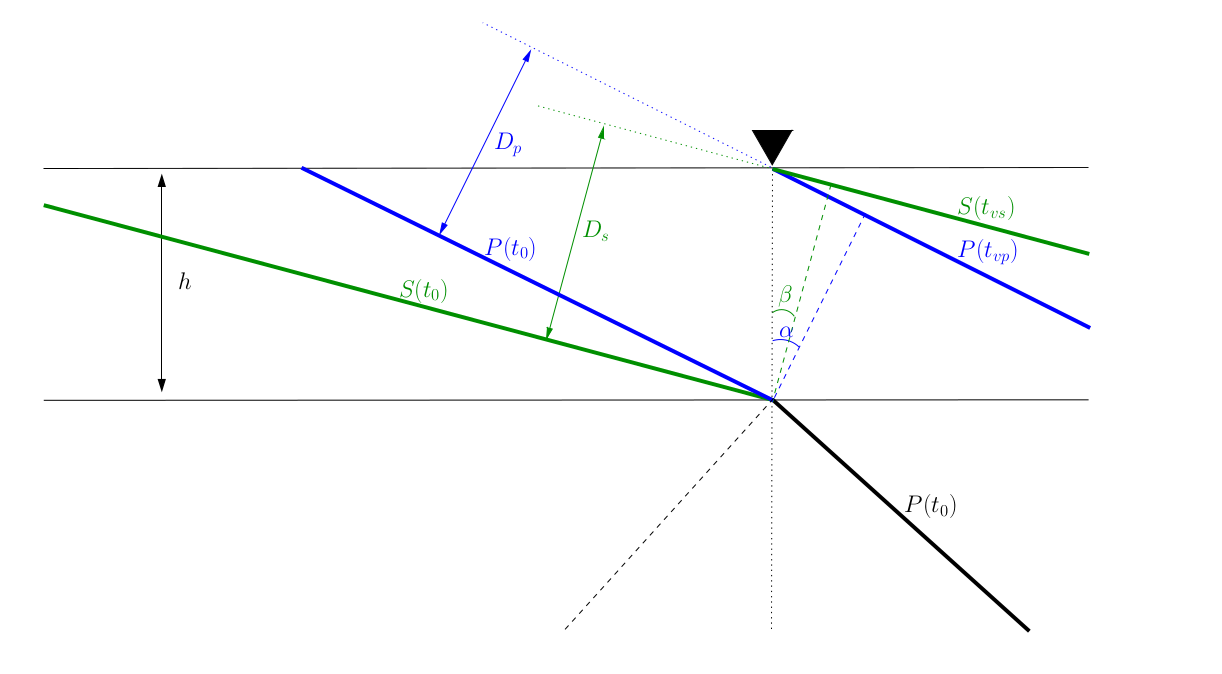
tdelay=ts-tsp=h(cos(b)/vs-cos(a)/vp)=h(qs-qp)
But, as I am understanding. Looking at the function (calculate\_delay\_times()), if we have sP conversion, we get:
dt= qp+qs-2(qs)=qp-qs
There is a sign different between both. But maybe I am wrong!
Let me know what you think.
Cheers!
---
### Author:  [@trichter](https://discourse.obspy.org/u/trichter)
#### Post date: [December 5, 2022, 9:50am UTC](https://discourse.obspy.org/t/s-receiver-functions/1576/5 "2022-12-05T09:50:26Z")
Hi! The delay time for sP conversions should be negative, because the converted P wave travels faster than the S wave. Therefore I think dt = qp-qs is correct. Shouldn’t it be tdelay=tsp-ts in your ansatz?
S receiver functions are mirrored later for a better comparison to P receiver functions.
---
### Author:  [@rafa0110](https://discourse.obspy.org/u/rafa0110)
#### Post date: [December 5, 2022, 10:24pm UTC](https://discourse.obspy.org/t/s-receiver-functions/1576/6 "2022-12-05T22:24:04Z")
Your are totally right Tom!. Thank you for explanation. In the SRF everything is related to the S waves, so makes sense to have negative relative time! Thanks again!
I am generating part of results from your package, that’s why I am aware of comments in the forum!